Instrument and equipment comparison
Music stands for home rehearsal: compare reading height, desk space and storage
A music stand has to put your score where you can read it, support the material you actually use and fit the space left around your instrument. A maximum-height number, a metal construction label or a carrying bag does not answer all three questions.
This listing-and-specification comparison considers the standard Manhasset 48 Symphony, On-Stage SM7222BB and KraftGeek Capsule. It is not a hands-on stability or load test, does not rank durability and does not choose an overall winner.
Manhasset 48 Symphony: a full-size desk and a non-folding base
Manhasset’s instructions and FAQ describe the standard Model 48 desk as 20 inches wide by 12½ inches high, with a 2¼-inch ledge. Its 26–48-inch range is measured from the floor to that ledge; the stated maximum overall height is 60½ inches. Do not compare its 48-inch ledge figure with another stand’s overall height as though they describe the same reading position.
The maker describes a fixed, three-foot base rather than a folding base. That matters when deciding where the stand will live between sessions. The standard Symphony, a shorter Concertino, a Tall version and the portable Voyager are not interchangeable versions of one height or storage specification.
The exact listing describes knob-free height and angle adjustment. That mechanism is a design feature, not proof of an unlimited load or years of trouble-free use. Check the exact stand and any proposed accessory before adding a heavy binder or tablet mount.
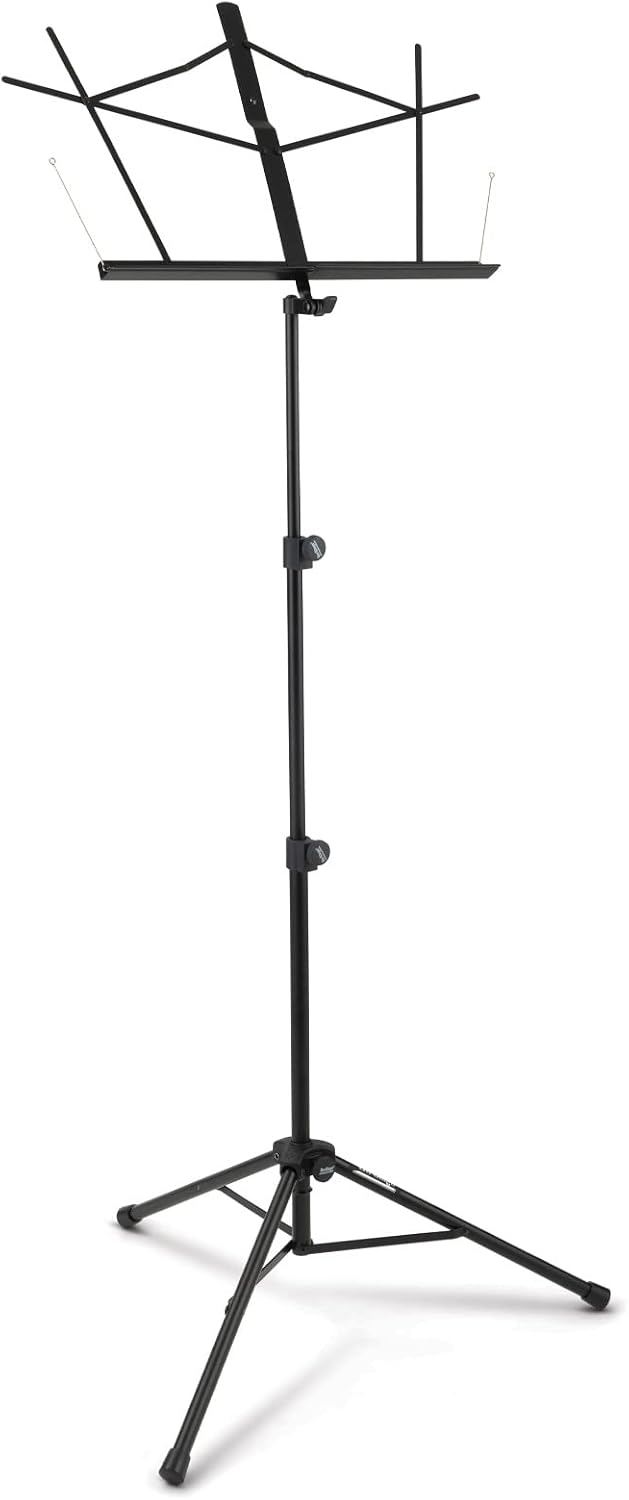
On-Stage SM7222BB: a folding bookplate and tripod base
The SM7222BB listing and maker catalog describe a folding bookplate, folding tubular-steel tripod legs, adjustable height and tilt, and a carrying bag associated with this model. Its height adjustment is listed as 20–52 inches. Confirm the measurement reference before using that number for a direct reading-height comparison with a floor-to-ledge specification.
Fold-out retainers and the open bookplate are relevant to loose pages, but check the actual open dimensions against your music. Do not treat a single bookplate dimension as the full usable width and height, or assume that a promotional page-count claim fits every score format.
Keep SM7222BB separate from the similarly named SM7122BB: the maker catalog gives them different height ranges and base designs. Tubular legs and rubber feet do not, by themselves, establish how the stand behaves on your floor, at full extension or with a particular load.
KraftGeek Capsule: folded size and reading height are different checks
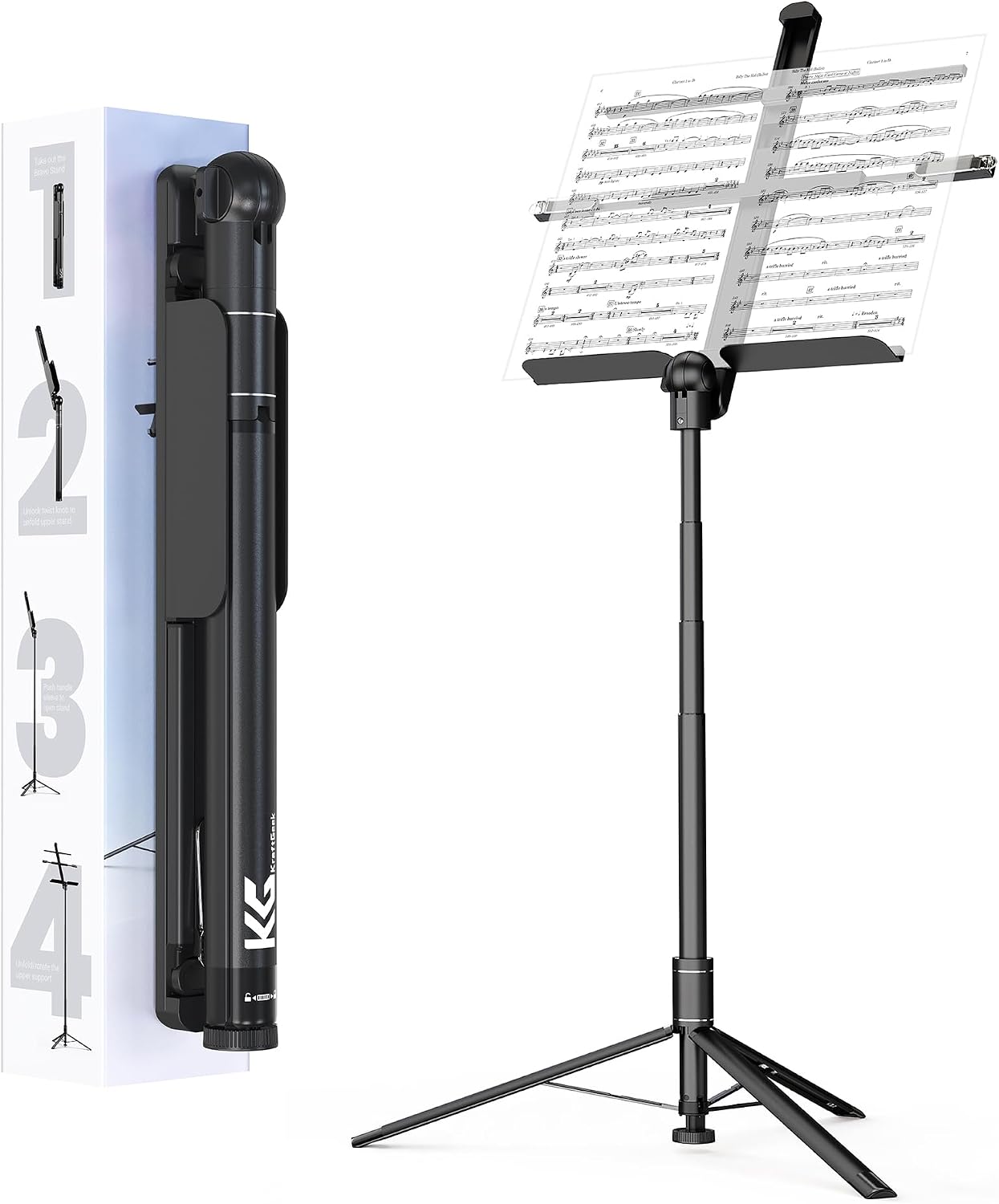
The exact Capsule listing describes a twist-to-open, folding stand with an expandable tray and page clips. KraftGeek’s product page lists a desk span of 18.9 by 15.4 inches and a folded length of roughly 17.2 inches. An expanded frame’s span is not the same as a continuous backing panel for a book.
The maker advertises a 29–66-inch height range but separately gives a maximum of 50 inches from the ground to the bottom of the desk. Do not interpret the 66-inch figure as a 66-inch music ledge. Check that the actual reading position works for you.
KraftGeek states a 2 kg load capacity. That is a manufacturer rating, not a result from our own load or wind test. The basic stand, accessory packages and Capsule Lite are separate checks; do not assume that a bag, light or device holder is included with the exact stand you are comparing.
Check reading height before comparing storage size
Sit or stand in your usual playing position and measure the height at which the bottom of your music should rest. Leave room for the instrument, your hands and the page turn. Then check whether the stand’s stated range refers to the bottom of the desk, its center or its highest point.
A folded dimension describes transport and storage, not the space used by the opened base. Allow room for the feet and for walking past the stand. If you move between rooms or lessons, check how the desk and legs fold, whether parts detach and what the exact package provides for carrying them.
Match the desk and load to your material
Measure the score open, not just the closed book. Compare the support behind the pages, the lower ledge, page retainers and the space needed for a binder’s spine. A wide frame is not necessarily a continuous backing surface, and a page clip is not proof that every book will stay open.
Treat a maker’s maximum load as a limit, not a guarantee of stability in every configuration. Include anything attached to the stand when checking the load. If no exact limit is established for the model, do not invent one from its material, appearance or another model’s specification.
Check the exact stand and package
Confirm the model, version, pack count and accessories. A stand pictured with a light, phone holder or several color options does not establish that those items arrive together. A model advertised as suitable for books or tablets still needs the right support and mounting arrangement for your particular item.
Choose from the reading position, support area and storage arrangement you need. Claims such as heavy-duty, wind-resistant or stable do not replace a specification or a relevant test of the setup you intend to use.